
Government Regulations on Tactile Flooring in India: RPwD Act, MoHUA 2021 & Guidelines for Banks and Offices
A plain-English guide to the latest Indian government rules and statutory standards for tactile indicators. Learn what the RPwD Act 2016, MoHUA 2021 guidelines, and RBI mandates require for corporate offices, banks, ATMs, IT parks, and commercial buildings.
Key Highlights at a Glance
- Tactile flooring is a legally mandatory requirement for banks, corporate offices, and commercial buildings under the RPwD Act 2016.
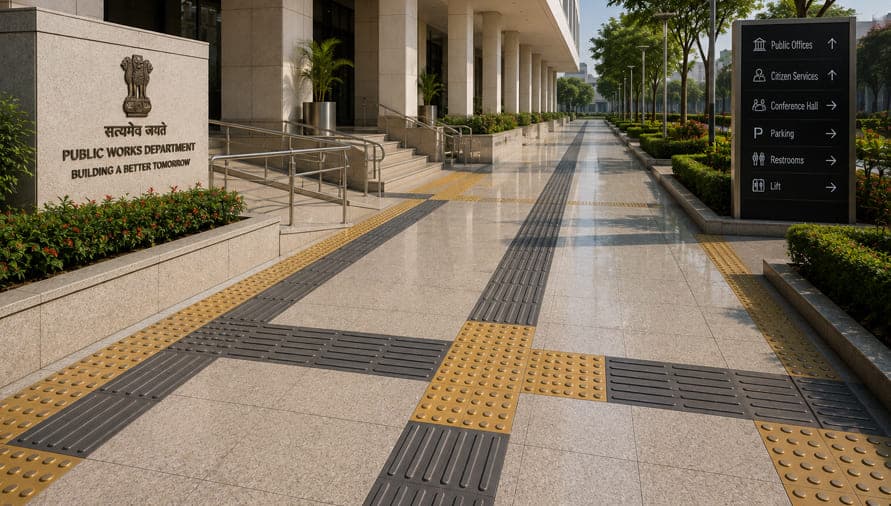
- MoHUA 2021 guidelines require hazard warning studs placed exactly 300mm before all stairs, lifts, escalators, and ramps.
- RBI mandates a continuous tactile path from bank entrances to teller counters and talking ATMs.
- Axiom Spaceworks delivers 100% compliant, audit-ready installations with official compliance documentation.
The Challenge & Industry Context
Many commercial landlords, IT facility managers, and bank branch heads across India are unaware that tactile flooring is not an optional aesthetic choice, but a strict statutory legal mandate under the RPwD Act 2016 and MoHUA guidelines. Commercial properties without compliant tactile pathways face delayed Occupancy Certificates (OC), failed fire audits, and severe legal notices under Section 89 of the Act.
Axiom Spaceworks conducts end-to-end statutory accessibility audits and turnkey installations for commercial facilities, corporate offices, and bank networks. We ensure 100% compliance with MoHUA 2021, NBC 2016, and RBI norms using certified Grade 304 stainless steel and high-contrast PU tactile indicators.
The 4 Main Government Standards Every Office & Bank Must Follow
Indian statutory authorities have established clear, non-negotiable rules for tactile floor indicators across all commercial and public properties:
RPwD Act 2016 (Sections 44, 45 & 89)
The Rights of Persons with Disabilities Act mandates barrier-free accessibility across all commercial and public buildings. Section 89 imposes heavy statutory financial penalties for non-compliance. Municipal corporations (like BMC, BBMP, DDA) now require certified accessibility compliance before granting or renewing commercial trade licenses and building Occupancy Certificates (OC).
MoHUA Harmonised Guidelines 2021 (Exact Measurements)
Published by the Ministry of Housing and Urban Affairs. It requires warning studs (Ø35mm × 5mm height) placed exactly 300mm before every staircase, elevator landing, escalator, and ramp. It also specifies directional guiding strips (280mm × 35mm × 5mm with smooth rounded bullnose ends) along all main corridors to guide white cane users.
RBI Directives for Commercial Banks & ATM Booths
The Reserve Bank of India mandates that all bank branches and ATM kiosks must provide a continuous tactile guiding path from the street or building gate straight to the teller counter and talking ATMs. Branches must also feature Grade 2 Braille signage, tactile counter numbers, and audio-enabled cash dispensers.
National Building Code (NBC 2016 - Part 3)
Mandates continuous tactile guidance routes leading directly to emergency fire escape stairs. Requires a 30% to 40% visual luminance contrast ratio between tactile indicators and the surrounding flooring, non-slip ramp transitions with a maximum 1:12 slope gradient, and dual-height handrails.
Why Following Government Accessibility Rules Matters to Your Business
Guaranteed Occupancy Certificates (OC)
Municipal planning authorities and fire departments conduct on-site physical audits. Installing certified tactile flooring ensures your building clearances, lease handovers, and OC approvals go through without delay.
Protection Against Legal Fines & PILs
Court rulings and disability commissioners actively issue notices and statutory penalties to non-compliant commercial complexes, hotels, and corporate parks under the RPwD Act.
Clear RBI Banking Audit Compliance
Public sector and private commercial banks face mandatory annual accessibility compliance checks. Proper tactile floor paths and Braille counter signage eliminate compliance audit objections.
How Axiom Spaceworks Executes This on Site
Statutory Gap Analysis & Architectural Audit
Our accessibility specialists review your floor plans against MoHUA 2021 and NBC guidelines, marking exact mandatory hazard warning zones, 300mm setback lines, and directional paths.
Luminance Contrast & Material Approval
We test the Light Reflectance Value (LRV) of your floor to guarantee the required 30%+ contrast ratio, recommending Grade 304 Stainless Steel for upscale corporate lobbies or Safety Yellow PU for high-traffic zones.
Precision Installation & Compliance Handover
Installed using laser alignment templates with zero-drill 3M VHB tape (for leased offices) or diamond-core pin anchors (for high-traffic public floors), accompanied by an official statutory compliance handover certificate.
Related Case Studies & Guides
View All 9 Guides →Tactile Flooring & RPwD Compliance in India
A clear, simple guide explaining how tactile ground surface indicators (TGSI) work in India. Learn the difference between warning studs (hazard alerts) and directional strips (guiding pathways), SS 304 vs PU materials, and how to meet statutory guidelines without damaging your floor.
Zero-Drilling Tactile Retrofit in Leased Offices
Corporate tenants in premium IT parks often cannot drill holes into expensive marble or granite floors due to strict landlord lease terms. Here is how industrial 3M VHB self-adhesive tactile systems solve this problem completely.
Braille Signage & Tactile Wayfinding Standards
How modern transit hubs, airports, and large corporate campuses implement standardized Braille signage and tactile wayfinding to create safe, self-reliant navigation for all visitors.
Speak with an Axiom Solutions Specialist
Share your project drawings, floor plans, or site details for immediate compliance checks and itemized cost estimates.